



Simplifying Radicals Worksheet Letter Size Overview
Math can be a tricky beast, especially when you're just starting out. Math worksheets in grade 1 are often the first real test of a child's number skills, and let's be honest, they can be a bit hit or miss. Here's the thing, though: these worksheets aren't just about getting the right answers; they're about building a foundation for future learning. So, if your child is struggling, it's not just about finding a quick fix—it's about understanding what's really going on.
Right now, as a parent or educator, you're probably feeling the pressure to make sure your child or student gets it right. The truth is, math anxiety can start early, and it’s often tied to those first experiences with worksheets. If grade 1 math feels like a hurdle, it’s not just about today’s homework—it’s about preventing a long-term struggle that could affect their confidence in all subjects.
Stick around, and you’ll discover why those seemingly simple worksheets matter more than you think, and how small adjustments can turn frustration into progress. Look, I get it—math isn’t everyone’s favorite topic, but by the end of this, you’ll have a clearer path forward. Oh, and I almost forgot—there’s a common mistake most parents make with these worksheets that’s actually doing more harm than good. But we’ll get to that later.
The Part of Math Worksheets in Grade 1 Most People Get Wrong
When it comes to early math education, there’s a common misconception that math worksheets in grade 1 are just about repetition and memorization. While practice is important, the real value lies in how these worksheets are used. Many parents and educators focus solely on completing the sheet, missing the opportunity to turn it into an interactive learning experience. Here’s what nobody tells you: worksheets are a tool, not the lesson itself. They should spark curiosity, not just test recall. For instance, instead of rushing through addition problems, pause and ask, “Why does 2 + 3 equal 5?” This simple shift can turn a mundane task into a conversation about number relationships, which is far more impactful.
Why Context Matters More Than Correct Answers
One of the biggest mistakes with math worksheets in grade 1 is treating them as a test rather than a teaching moment. A child who gets 8 out of 10 problems right isn’t necessarily struggling—they might just need more contextual understanding. For example, if a worksheet asks, “How many apples are left if you have 5 and eat 2?” connect it to real life. Use actual apples or draw pictures to visualize the problem. This approach helps children see math as a problem-solving tool, not just a set of rules to follow. Without context, worksheets can feel abstract and unengaging, making it harder for kids to retain what they’ve learned.
The Role of Play in Early Math Learning
Here’s a secret: play-based learning should complement worksheets, not compete with them. Grade 1 is a critical age for developing a positive attitude toward math, and worksheets alone can’t achieve that. Incorporate games like counting blocks, dice rolling, or even a simple scavenger hunt with numbers. These activities reinforce concepts in a way that feels fun, not forced. For example, after completing a worksheet on counting by tens, play a game where kids jump forward in tens. This blend of structured practice and playful exploration ensures that math becomes a part of their daily lives, not just a classroom chore.
How to Choose the Right Math Worksheets for Grade 1
Look for Variety, Not Just Quantity
Not all worksheets are created equal. When selecting resources, prioritize those that offer diverse problem types and real-world applications. Avoid sheets that rely heavily on rote memorization or repetitive tasks. Instead, opt for ones that include word problems, visual aids, or even story-based scenarios. For instance, a worksheet that asks, “If there are 4 birds on a branch and 2 fly away, how many are left?” is far more engaging than a list of subtraction problems. This variety keeps kids interested and helps them apply math in different contexts.
Balance Structure with Flexibility
While worksheets provide structure, they shouldn’t be rigid. Allow room for mistakes and exploration. If a child struggles with a concept, don’t rush to correct them—let them explain their thinking. This fosters critical thinking and shows them that math is about reasoning, not just right answers. Additionally, mix worksheets with hands-on activities. For example, after practicing basic addition, use manipulatives like beads or buttons to physically demonstrate the concept. This dual approach ensures that learning is both guided and adaptable.
Track Progress, Not Just Performance
Finally, use worksheets as a tool to monitor growth, not just performance. Keep an eye on how a child approaches problems over time—are they using more efficient strategies? Are they asking questions that show deeper understanding? Celebrate small wins, like when they start explaining their steps aloud. This focus on progress, rather than perfection, builds confidence and keeps the learning process enjoyable. Remember, the goal isn’t to finish every worksheet; it’s to build a foundation for lifelong math skills.
Your Child's Math Journey Starts Here
As you step back and look at the bigger picture, it's clear that a strong foundation in math is crucial for your child's future success. Whether they dream of becoming a scientist, an engineer, or simply want to navigate everyday life with confidence, math worksheets in grade 1 play a vital role in building that foundation. By engaging with these resources, your child will not only develop essential skills but also cultivate a love for learning that will serve them well throughout their academic journey and beyond. Isn't it amazing to think about the doors that could open for them?
You might be wondering if it's really necessary to start so early, or if your child is ready for this level of challenge. Rest assured, math worksheets in grade 1 are designed to be accessible, engaging, and most importantly, fun. With a gentle learning curve and plenty of opportunities for practice, your child will be well-supported as they take their first steps into the world of math. There's no need to worry – this is a natural and exciting part of their development.
As you prepare to embark on this journey with your child, take a moment to browse our collection of resources, bookmark this page for future reference, or share it with a fellow parent who might benefit from this guidance. By doing so, you'll be helping to create a community of confident, capable young learners – and that's a truly rewarding prospect. So go ahead, take that next step, and watch as your child's love for math begins to flourish.
Related: Free Printable Spelling ING Worksheets (PDF for Kids)
You've handed out the same fill-in-the-blank worksheet three times this month, and the kids still can't decide if they're "swiming" or "swimming." Here's the thing — that double-letter rule trips up everyone, from second graders to adults writing emails. The frustration is real, and it's costing you precious teaching time. Look — if you're tired of seeing "runing" and "hoping" when it should be "running" and "hopping," you're not alone. This is the exact moment to stop guessing and start using a spelling ing worksheet that actually works.
Real talk: most worksheets out there are garbage. They throw twenty random verbs at kids and expect them to magically memorize the pattern. That's not how the brain learns this stuff. The "ing" suffix is deceptively tricky because it forces you to think about consonant doubling, vowel stress, and silent-e dropping all at once. No wonder kids freeze up. But here's what I've learned after fifteen years of writing curriculum — when you isolate the rule and build it step by step, the confusion dissolves fast.
By the time you finish reading what's coming next, you'll have a clear strategy for teaching this rule that doesn't rely on rote memorization. No fluff. No motivational poster quotes. Just a worksheet structure that makes the lightbulb go off — and keeps it on. I'll show you the exact layout, the progression of difficulty, and the one mistake most teachers make that turns "ing" into a nightmare. You ready? Because this is the part where everything clicks.
If you've ever watched a child stare blankly at a page full of "-ing" verbs, you know the struggle is real. The spelling ing worksheet has become a staple in classrooms and homeschools alike, but most of them miss the point entirely. They treat adding "-ing" as a simple mechanical rule, when in reality it's a minefield of double consonants, silent-e drops, and vowel shifts that can trip up even confident fourth-graders. The real value isn't in filling out twenty blanks—it's in building a mental reflex for when to double that last letter and when to leave it alone.
Why Most "-ing" Practice Sheets Fail (And One That Doesn't)
The typical worksheet asks kids to add "-ing" to a list of base words like "run," "make," and "jump." That's fine for warm-up, but it teaches zero strategy. Here's what nobody tells you: the single most effective approach is teaching the "CVC" (consonant-vowel-consonant) pattern visually. When a child can look at a word like "hop" and see that it ends in a consonant-vowel-consonant sequence, they instantly know to double the final consonant before adding "-ing." But a word like "help" ends in two consonants—so no doubling. Simple, right? Yet most worksheets never explicitly teach this pattern. They just assume kids will absorb it through repetition. They won't.
I've seen too many worksheets that cram every possible rule—doubling, dropping e, changing ie to y—into one chaotic page. That's not practice; that's confusion. A better approach isolates one rule at a time. For example, a dedicated page on silent-e drop words like "bake → baking" or "write → writing" lets a child build fluency before layering in the doubling rule. The best spelling ing worksheet I've ever used had a simple three-column layout: base word, rule applied, and final word. No fluff, no cartoons, just clear visual logic that a seven-year-old could follow independently.
The One Rule That Changes Everything
There's a single pattern that, once mastered, unlocks about 70% of all "-ing" spellings. It's the "short vowel + single consonant" rule. If the base word has one short vowel followed by exactly one consonant (like "sit," "run," "stop"), you double that consonant before adding "-ing." If the vowel sound is long, or if there are two consonants already, you don't double. I've watched kids go from guessing to confidently writing "sitting" versus "waiting" in a single session when this rule is taught with physical letter tiles or color-coded cards. A worksheet that forces them to sort words into "double" and "no double" columns builds this reflex far better than a list of fill-in-the-blanks.
Why "Drop the E" Deserves Its Own Day
The silent-e rule is where most worksheets go off the rails. Words like "come → coming" or "have → having" follow a straightforward pattern—drop the e, add -ing—but kids often over-apply it. They see "see" and want to write "seing" instead of "seeing." The trick is teaching that the silent e must be dropped only when it makes the vowel say its long sound. A targeted worksheet that pairs each base word with its "-ing" form in a matching activity works wonders here. One specific, actionable tip: use a highlighter to mark the silent e in the base word, then have the child physically cross it out before writing the "-ing" form. That kinesthetic step cements the rule far better than staring at a page.
How to Judge a Worksheet Before You Print It
Not all practice pages are created equal. I've sorted through dozens, and the good ones share three traits. First, they limit the number of rules per page—ideally one, max two. Second, they include a visible rule reminder at the top, not buried in instructions. Third, they offer a mix of word sorting, sentence completion, and error correction, not just rote conjugation. Here's a quick comparison of common worksheet types:
| Worksheet Type | Best For | Common Weakness |
|---|---|---|
| Fill-in-the-blank (base word given) | Quick warm-up or review | No rule reinforcement; kids guess |
| Sorting into columns (double vs. no double) | Building pattern recognition | Can feel repetitive after 10 words |
| Error correction (find the misspelled -ing word) | Applying rules critically | Harder for struggling readers |
| Sentence-level application | Transferring skill to real writing | Requires stronger vocabulary |
When to Push Pause on the Worksheet
If a child is consistently misspelling the same pattern—say, always forgetting to double the consonant in "stopping"—a worksheet won't fix it. That's a signal to go hands-on. Grab magnetic letters or a whiteboard. Build the word, say it aloud, add the "-ing" physically. The worksheet should come after the concept is clear, not before. I've seen too many frustrated kids hate spelling because they were handed a page of rules they didn't understand. A good worksheet reinforces; it doesn't teach from scratch.
One Final Reality Check
Here's the honest truth: no single worksheet will fix spelling struggles. But a well-designed one—focused, sequential, and rule-conscious—can turn a confusing mess into a manageable pattern. The best spelling ing worksheet I've seen was a single page with ten words, a color-coded rule box, and a challenge to write two original sentences using those words. It took ten minutes and left the kid feeling capable, not defeated. That's the real goal. Not perfection. Just progress.
Your Next Step Starts Here
This isn’t just about worksheets or verb endings. It’s about the quiet confidence a child carries when they finally see the pattern behind the spelling. Every time a student pauses, thinks, and correctly writes “running” instead of “runing,” they aren’t just learning a rule—they are building a mental framework for decoding language. That framework touches everything: reading comprehension, written expression, even how they speak. The small victories in a spelling ing worksheet ripple outward into every subject that requires clear writing. You’re not filling out a piece of paper; you’re wiring a brain for clarity.
Maybe you’re thinking, “But my child still mixes up ‘hoping’ and ‘hopping’—will this really stick?” Let that doubt go. Mastery isn’t a straight line; it’s a spiral. They’ll forget, then remember, then forget again. That’s normal. What matters is that you keep bringing them back to the practice with patience and a low-stakes tool. A worksheet isn’t a test—it’s a playground for the rules. The repetition isn’t punishment; it’s the gentle groove that turns confusion into instinct.
So here’s your invitation: don’t just read and walk away. Bookmark this page for the next rainy afternoon. Print a fresh spelling ing worksheet and leave it on the kitchen table with a favorite pen. Better yet, share this article with a fellow parent or teacher who’s been scratching their head over the same struggle. One shared resource can save someone hours of frustration. The goal isn’t perfection—it’s progress. And you’ve just handed yourself the key to that progress.
Related: 11 Abc Order Worksheets for Kids
As a parent or teacher, you know the importance of finding engaging and practical resources to support learning. ABC order worksheets are a brilliant tool to have in your teaching kit, offering a simple yet effective way to practice and reinforce alphabet skills. These worksheets, like alphabetical order worksheet for kindergarten, are especially handy when you want a quick activity to keep kids focused and learning, whether it's at home or in the classroom. 29 Verb to Be Worksheets for Practice
Writing practice for beginners.
Alphabetical Order: A Foundational Skill
Learning the alphabet is a cornerstone of early education, and ABC order worksheets are a fantastic tool to reinforce this essential skill. These worksheets provide a structured yet engaging way for children to practice arranging letters and words, fostering their understanding of alphabetical order.
Preschool alphabet order fun.
Simple Practice Sheets for Early Learners
When it comes to alphabetical order worksheet for kindergarten, the focus is on making learning fun and accessible. These worksheets often feature bright, appealing designs and simple instructions, ensuring that young learners stay engaged. They might include activities like matching uppercase and lowercase letters, ordering simple words, or even a fun alphabet challenge game.
Alien-themed alphabetical order.
For instance, a kindergarten worksheet might ask children to arrange a set of pictures in alphabetical order, with each picture representing a familiar object or animal. This activity not only reinforces letter recognition but also introduces the concept of alphabetical order in a playful manner.
Identifying A-B patterns.
People Also Ask: What's the Best Way to Use ABC Order Worksheets?
A common curiosity among parents and educators is how to maximize the educational value of these worksheets. The key lies in choosing the right worksheet for the learner's skill level and using it as a tool to build upon existing knowledge.
Out-of-order alphabet challenge.
For beginners, start with simple practice sheets that focus on letter recognition and basic ordering. As children progress, introduce more complex worksheets that incorporate word order, sentence structure, or even paragraph organization. This progressive approach ensures that learners are consistently challenged and motivated.
ABC order mats for kids.
How to Incorporate ABC Order Worksheets into Learning
Whether you're a teacher, parent, or tutor, there are numerous ways to integrate ABC order worksheets into your educational routine. In a classroom setting, these worksheets can be used as a warm-up activity to get students focused and ready for the day's lesson. They're also excellent for small group work, allowing students to collaborate and learn from each other.
Learning to write step by step.
For homeschooling or tutoring sessions, ABC order worksheets can be a valuable tool for individualized learning. They provide a structured way to assess a child's understanding of alphabetical order and identify areas where they might need extra support or challenge.
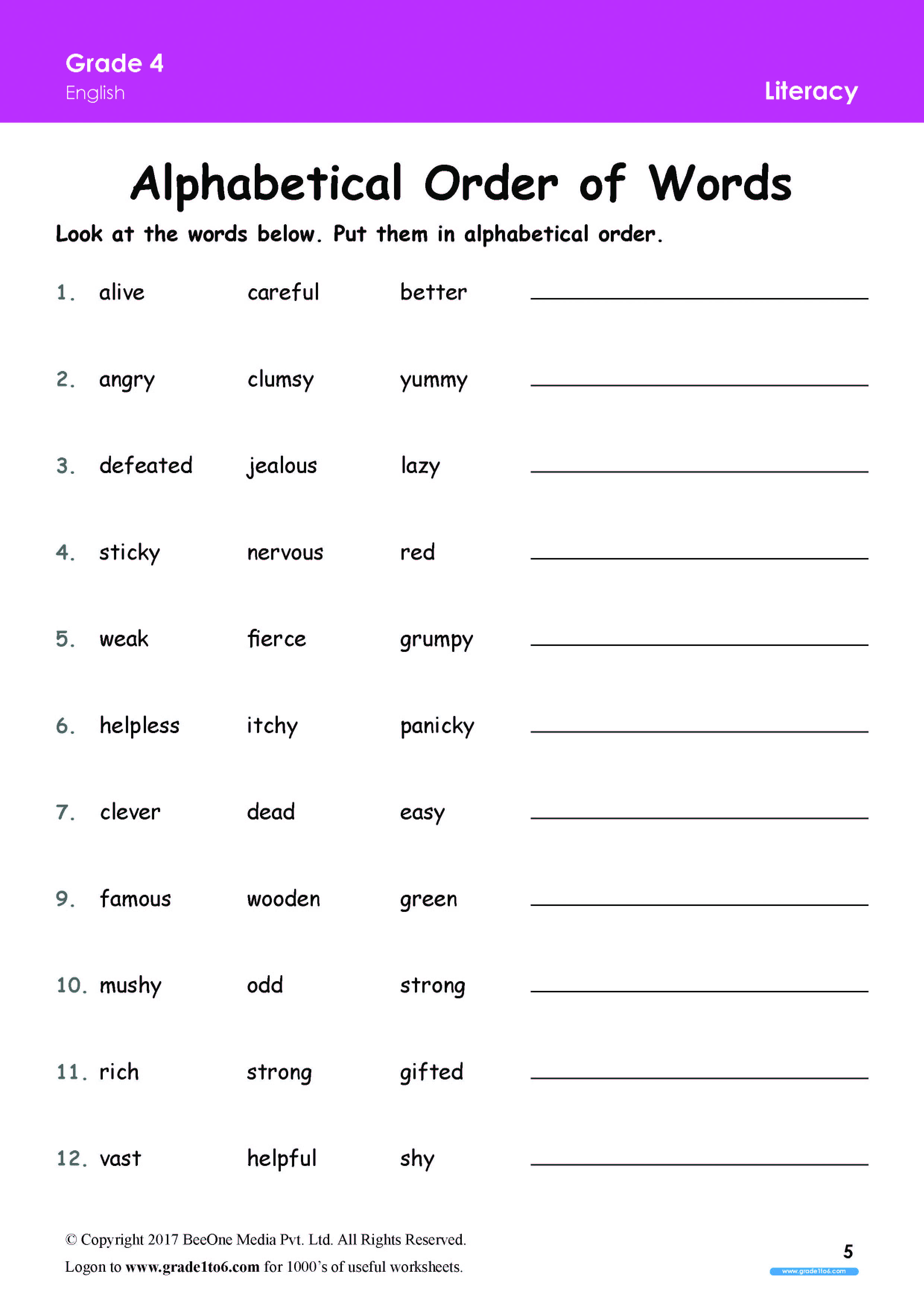
Grammar activities for 3rd-4th graders.
When using worksheets at home, it's important to create a dedicated learning space and establish a routine. This helps children understand that worksheet time is a special part of their day, fostering a positive attitude towards learning.
ABC order templates for any word.
Organized Lists: A Fun Way to Learn
One of the great benefits of ABC order worksheets is that they teach children an important life skill: organizing information. By arranging letters and words in a logical sequence, children develop an understanding of how to create organized lists, a skill that will serve them well throughout their academic and professional lives.
Practice sorting words alphabetically.
Additionally, these worksheets can be a great way to introduce children to the concept of reference materials. By learning to use alphabetical order to locate information, children develop research skills that will be invaluable as they progress through their education.
Abc order list for all.
In conclusion, ABC order worksheets are a versatile and effective tool for teaching alphabetical order and organization skills. Whether used in the classroom, for homeschooling, or as a fun learning activity at home, these worksheets provide a structured yet engaging way for children to practice and reinforce this foundational skill. What 2voice Trademark Means for It Tech With a wide range of free abc order worksheets available, including abc order worksheets blank, abc order worksheets printable pdf, and abc order worksheets grade 2, there's a resource to suit every learner's needs.
Alphabetical order worksheets.
Hey there! We hope you're feeling inspired to dive into the world of ABC order worksheets. These resources are a brilliant way to make learning fun and interactive for little ones.
So, why not give it a go? Print out a few worksheets, gather your kids or students, and watch as they grasp this foundational skill with ease. We'd love to hear how it goes, so feel free to leave a comment and share your experiences!
Sort words for 3rd graders.
Read also: 16 Color By Number Math Worksheets for Kids


