






Lego Therapy Worksheets 2026 Overview
Kids hate boring math drills, and coloring worksheets with subtraction are the secret weapon you’ve been ignoring. Honestly, who doesn’t love coloring? It’s like sneaking veggies into a smoothie—they’re having fun, but they’re actually learning something crucial. These aren’t your grandma’s worksheets; they’re a clever blend of creativity and problem-solving that keeps kids engaged without them even realizing they’re practicing subtraction.
Right now, your kid is probably staring at a screen or complaining about math homework. Sound familiar? Coloring worksheets with subtraction are the perfect antidote to the digital overload and math meltdowns. They’re not just a trend—they’re a lifeline for parents and teachers who want to make learning stick without the drama. Plus, they’re a great way to unwind after a long day of school or work, for both kids and adults alike.
Look, I’m not saying these worksheets will turn your kid into a math genius overnight, but they’ll definitely make subtraction less of a headache. Stick around, and you’ll discover how to pick the right ones, why they work so well, and a few tricks to make them even more effective. Trust me, this is one parenting hack you won’t want to miss.
The Hidden Challenge in Coloring Worksheets with Subtraction
Most educators and parents assume coloring worksheets with subtraction are straightforward. Kids solve a problem, then color the corresponding area. Simple, right? Not quite. The real challenge lies in balancing the educational value with engagement. Too often, these worksheets become rote tasks where kids rush through subtraction to get to the coloring. Here’s what nobody tells you: the math should be the star, not the coloring. If the subtraction problems aren’t thoughtfully designed, the worksheet loses its purpose. For instance, a worksheet with random numbers (e.g., 12 - 5) might bore a child who’s already mastered single-digit subtraction. Instead, **tailor the problems to their skill level**—use double-digit subtraction or introduce borrowing for older kids. This keeps the math relevant while the coloring remains a reward, not the main event.
Why Skill Level Matters More Than You Think
A common mistake is treating coloring worksheets with subtraction as one-size-fits-all. A first-grader and a third-grader have vastly different needs. For younger kids, keep the subtraction simple but engaging—think 10 - 3 or 8 - 4. For older students, ramp up the complexity with problems like 42 - 18 or 55 - 27. The key is to avoid frustration. If a child spends more time guessing than calculating, they’ll tune out. Here’s a pro tip: Include a mix of easy and challenging problems within the same worksheet. This builds confidence while gently pushing their limits. For example, a worksheet with 7 - 2, 15 - 8, and 34 - 12 keeps them on their toes without overwhelming them.
The Coloring Component: More Than Just Filler
The coloring part of these worksheets isn’t just downtime—it’s an opportunity to reinforce learning. Use the coloring to highlight patterns or sequences related to the subtraction problems. For instance, if the worksheet focuses on subtracting by 5s, design the coloring areas to create a pattern that repeats every 5 spaces. This subtly ties the math to visual learning. **Avoid generic designs** like flowers or animals unless they directly relate to the math. Instead, opt for grids or shapes that align with the subtraction theme. This way, the coloring becomes an extension of the lesson, not just a break from it.
Turning Coloring Worksheets with Subtraction into a Learning Powerhouse
Incorporate Real-World Scenarios for Deeper Engagement
Subtraction doesn’t exist in a vacuum—it’s a tool for solving real problems. Bring this to life in your worksheets by framing problems around everyday situations. For example, “If you have 15 apples and give 7 to your friend, how many do you have left?” Pair this with a coloring area that shows apples being shared. This not only makes the math relatable but also helps kids see its practical application. **Actionable tip**: Use seasonal themes to keep it fresh. During Halloween, subtract candy counts; during summer, subtract picnic items. This keeps the worksheets dynamic and connected to their world.
Leverage Technology for Interactive Learning
While traditional worksheets have their place, don’t overlook digital tools. Apps and online platforms can turn coloring worksheets with subtraction into interactive experiences. Kids can drag and drop numbers, watch animations for correct answers, or even color digitally. This blends the tactile joy of coloring with the instant feedback of technology. However, balance is key—too much screen time can dilute the focus on math. Use digital tools as a supplement, not a replacement, for paper-based worksheets. And yes, that actually matters when you’re trying to keep kids engaged without overstimulating them.
Track Progress Without Overwhelming
Finally, use these worksheets as a tool for tracking progress. Include a small section at the bottom where kids (or parents) can note the date and any challenges they faced. Over time, this creates a visual record of their growth. **Avoid turning it into a test**—keep the tone encouraging, not evaluative. For example, instead of “Score: __/10,” use “I rocked these problems today: __.” This shifts the focus from perfection to effort, making learning feel less intimidating and more rewarding.
- Tailor problems to skill level to keep math engaging.
- Use coloring to reinforce patterns or sequences.
- Incorporate real-world scenarios for relatability.
- Blend traditional and digital tools for variety.
- Track progress in a positive, non-judgmental way.
Your Next Step Starts Here
In the grand scheme of things, teaching kids essential skills like subtraction doesn’t just prepare them for math class—it sets the foundation for problem-solving, critical thinking, and confidence in their abilities. Coloring worksheets with subtraction aren’t just about numbers; they’re about blending creativity with learning, making education feel less like a chore and more like an adventure. When kids engage with these tools, they’re not just memorizing facts—they’re building a mindset that says, “I can figure this out.” And that’s a lesson that sticks with them far beyond the classroom.
You might be thinking, “But will my child really enjoy this?” Trust me, the combination of coloring and learning is a game-changer. Kids love to create, and when you add a dash of problem-solving to their favorite activity, it becomes something they look forward to. The hesitation you feel? It’s normal. But remember, the best learning happens when it feels like play. These worksheets are designed to meet kids where they are, making subtraction accessible and fun.
So, take a moment to explore the gallery of coloring worksheets with subtraction and see which ones spark excitement for your little learner. Bookmark this page for later, or share it with a friend who’s looking for fresh ways to teach math. Every small step you take today could be the one that makes a big difference tomorrow. Go ahead—give it a try and watch the magic unfold.
Related: 31 Types of Reactions Worksheets
Sometimes, finding the right resources to support our learning journey can be a bit of a challenge, especially when it comes to mastering specific topics like chemistry. That's why I'm excited to share a helpful tool: the types of reactions worksheet. This handy resource is a great way to practice and reinforce your understanding of chemical reactions, and it's perfect for students, parents, and teachers alike. With a classifying reactions worksheet like this, you can easily determine each type of reaction and improve your skills.
Graphing lines: horizontal and vertical.
Understanding Chemical Reactions: A Comprehensive Guide
Chemical reactions are an essential concept in chemistry, and mastering them is a crucial step in developing a strong foundation in the subject. The types of reactions worksheet is an excellent tool to enhance your understanding and practice of chemical reactions, covering a wide range of reaction types.
Classifying chemical reactions.
Exploring Different Worksheet Types
When it comes to chemical reaction worksheets, there are various formats and activities to choose from, catering to different learning styles and preferences. Some worksheets focus on identifying and classifying reactions, while others provide more in-depth practice with specific reaction types, such as synthesis or decomposition. These worksheets often include a mix of multiple-choice questions, fill-in-the-blank exercises, and short answer prompts to reinforce understanding.
Solving log equations: the key.
People Also Ask: What Are the Different Types of Chemical Reactions?
Understanding the different types of chemical reactions is fundamental to chemistry. The types of reactions worksheet typically covers the following reaction categories: synthesis, decomposition, single displacement, double displacement, combustion, and redox reactions. Each type has its own unique characteristics and is essential to grasp for a comprehensive understanding of chemical processes.
Writing chemical reaction types.
How to Use the Types of Reactions Worksheet Effectively
The types of reactions worksheet can be a versatile tool for learning and reinforcement. For students, it serves as an excellent practice resource, allowing them to apply their knowledge and identify reaction types independently. Teachers can incorporate these worksheets into lesson plans, using them for in-class activities, homework assignments, or even as a basis for group discussions and collaborative learning. Parents can also utilize these worksheets for homeschooling or as supplementary materials to support their child's learning journey.
Special segments in triangles.
When using the worksheet, it's important to consider the learner's age and grade level. While the concept of chemical reactions is typically introduced in middle school, the difficulty level can be adjusted to cater to different abilities. For younger learners, focusing on simpler reaction types and providing more visual aids can be beneficial. As students progress, more complex reactions and advanced concepts can be introduced.
Identifying and balancing reactions.
Practical Application: Classifying Reactions and Beyond
The classifying reactions worksheet is an excellent starting point for practicing chemical reactions, but it's just the beginning. Once learners have a solid understanding of reaction types, they can move on to more advanced worksheets that delve deeper into specific reaction mechanisms and their applications. These worksheets often include real-world examples and practical scenarios, helping students connect their knowledge to everyday life.
Types of balancing reactions.
For instance, a more advanced worksheet might explore the concept of neutralization reactions and their role in everyday phenomena, such as the reaction between an acid and a base to form water and a salt. By understanding these real-world applications, students can see the relevance and importance of chemical reactions beyond the classroom.
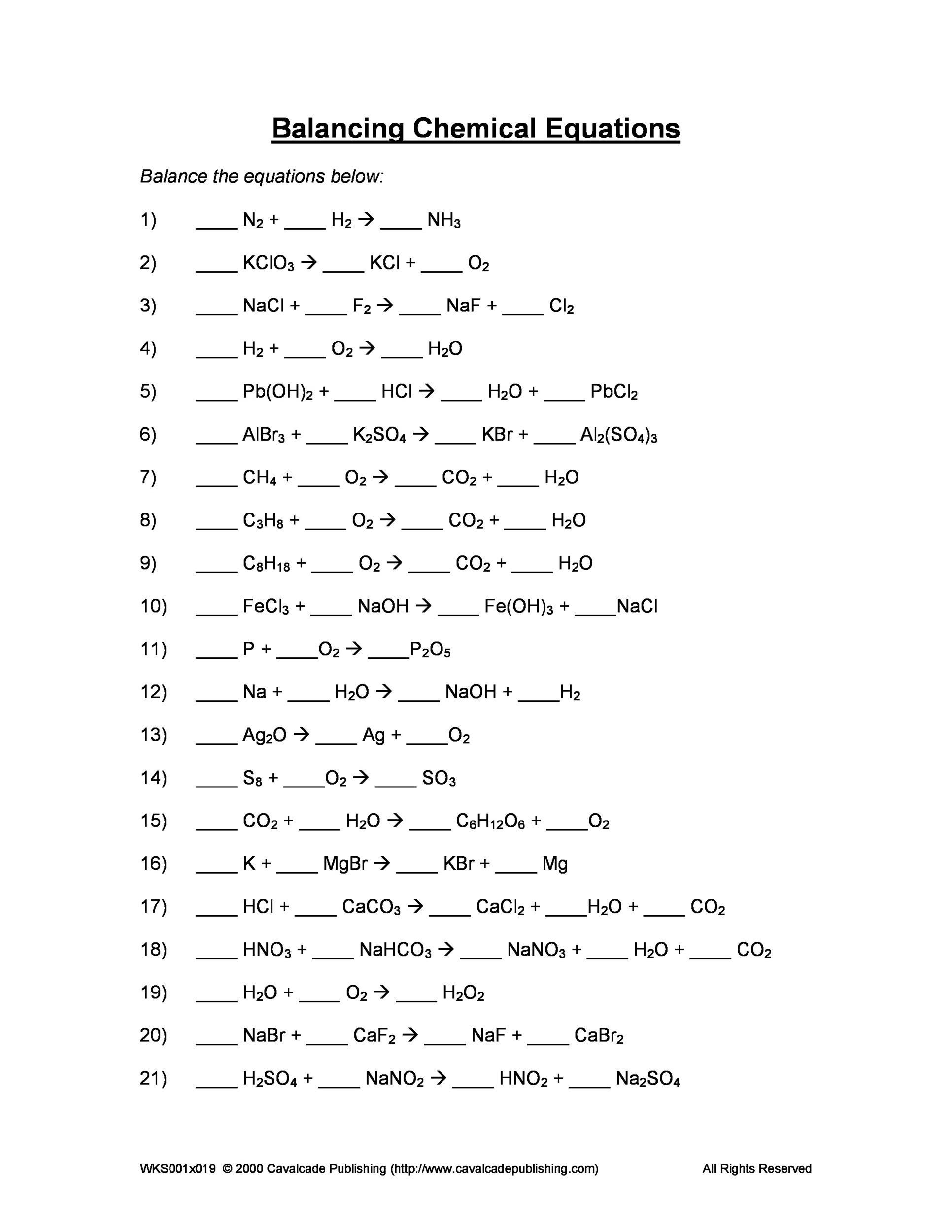
Balancing chemical equations.
Furthermore, the types of reactions worksheet can be a valuable resource for review and revision. Students can use these worksheets to refresh their memory before exams or to identify areas where they may need further practice and reinforcement. Teachers can also assign these worksheets as a form of formative assessment to gauge student understanding and provide targeted feedback.
Functions for 8th grade.
In conclusion, the types of reactions worksheet is a versatile and practical tool for learning and practicing chemical reactions. By providing a structured and engaging format, it caters to a wide range of learners and learning environments. Whether used in the classroom, for homeschooling, or as a supplementary resource, this worksheet plays a vital role in building a strong foundation in chemistry.
Surprises and reactions.
Free types of reactions answers.
Graphing parallel and perpendicular lines.
Well, there you have it! The types of reactions worksheet is a fantastic resource to deepen your knowledge and get hands-on with chemical reactions. It's a great way to reinforce your understanding and make learning more enjoyable.
So, why not give it a go? Print out the worksheet, gather your materials, and start experimenting. It's a fun and effective way to learn, and you might just discover a new passion for chemistry! Leave a comment or share your experience below; I'd love to hear how it went for you and any tips you have for fellow learners.
Fun learning with Pokemon.
Read also: 17 Pattern Worksheets for Kindergarten
Related: Free Printable Reading Worksheets for Year 7 Students
Most parents assume Year 7 is when kids magically stop needing reading help. Here's the thing — that assumption is why so many students fall behind before October half-term. The jump from primary to secondary school isn't just bigger backpacks and new teachers; it's a brutal leap in reading complexity that catches even confident readers off guard. That's precisely where targeted reading worksheets year 7 come in — not as busywork, but as the actual scaffolding most students quietly need.
Look, your child is suddenly facing Shakespeare extracts, dense science textbooks, and history sources written in language nobody actually uses anymore. Schools assume they'll just "pick it up." But the truth is, most Year 7s are faking it — nodding along in class while silently drowning in vocabulary they can't decode and inferences they can't spot. This isn't about being "behind." It's about the curriculum expecting a reading maturity that developmentally, many 11- and 12-year-olds simply haven't built yet. And honestly? That's not their fault.
What I'm going to show you aren't those dull comprehension sheets from primary school with ten predictable questions. Instead, we're talking about worksheets that actually mirror what secondary teachers expect — the kind that train a student to spot a writer's bias before they've even finished the paragraph. The kind that make skimming for key information feel automatic rather than exhausting. You'll walk away with specific strategies that slot into twenty minutes after dinner, not another hour-long battle over homework. Keep reading — because the gap between where your Year 7 is and where they need to be is narrower than you think, but it won't close by itself.
If you've spent any time looking for teaching materials for twelve-year-olds, you've probably noticed something odd. Most reading resources aimed at this age group are either painfully childish or surprisingly dense. They assume kids either need picture books or university-level analysis. The reality sits somewhere in between, and that's where well-designed reading worksheets for year 7 students actually come into their own. The trick is knowing what makes them work—and what makes them fail.
The Hidden Problem with Most Year 7 Reading Materials
Here's what nobody tells you: the jump from primary to secondary school reading isn't just about harder words. It's about a shift in cognitive demand that catches most students off guard. Year 7 pupils are expected to move from "what happened in the story" to "why did the author choose that word, and what effect does it have?" That transition is brutal for many kids. I've seen bright readers freeze when asked to explain subtext, because nobody ever taught them how to look for it. Effective reading worksheets for year 7 should bridge this gap explicitly—not by dumbing down the text, but by scaffolding the thinking process. One actionable tip: choose passages where the author's tone is deliberately ambiguous. A character saying "that's just great" after losing a match forces students to infer sarcasm versus genuine relief. That single moment of confusion is where real comprehension starts.
What Strong Comprehension Practice Actually Looks Like
Most worksheets fail because they treat reading as a passive activity. You read, you answer five questions, you move on. That's not engagement—that's a chore. Strong materials demand something different. They ask students to annotate the text directly, highlight patterns, and defend their interpretations with evidence. For example, a good exercise might present a short extract where a character's dialogue contradicts their actions. The question isn't "what happened?" but "where is the tension between what this character says and what they do? Prove it." This trains the brain to read actively, not just decode words. It also mirrors what secondary school assessments actually require—analysis, not summary.
Why Vocabulary Work Can't Be an Afterthought
Year 7 is a vocabulary explosion year. Students encounter subject-specific terms across history, science, and literature all at once. Yet many reading resources treat vocabulary as a separate box to tick—a list of definitions to memorise. That's useless. The most effective approach embeds vocabulary instruction directly inside the reading task. If a passage uses the word "melancholy," don't just define it. Ask students to find three clues in the text that support that mood. Then ask them to rewrite the sentence using a synonym and explain how the tone shifts. This kind of layered practice sticks. It builds a mental web around the word, not a one-line definition that vanishes by Friday.
| Skill Focus | Common Weak Practice | Strong Alternative |
|---|---|---|
| Inference | "What did the character feel?" | "Find two pieces of textual evidence that prove the character is lying." |
| Vocabulary | Define the word in one sentence. | Replace the word with a synonym and explain how the meaning changes. |
| Structure | "What happens at the start?" | "Why does the author delay revealing the character's name until paragraph three?" |
How to Spot Materials That Actually Build Skills
Not all resources are created equal. The market is flooded with generic PDFs that look professional but teach nothing. The difference comes down to one thing: whether the task forces the student to think harder than the text itself. If a worksheet can be completed by skimming for a bolded word and copying it, it's not teaching comprehension—it's teaching search skills. Real growth happens when the worksheet asks something that can't be answered by scanning alone. For instance, a passage might describe a storm as "the sky's clenched fist." A weak question asks, "What is the weather like?" A strong question asks, "Why does the author choose a metaphor of violence for the weather? What does that suggest about the scene to come?" That second question demands synthesis, not retrieval. And that's where the learning actually lives.
Balancing Challenge with Confidence
There's a fine line between stretching a student and breaking their confidence. Year 7 readers are still fragile in their literary identity. Too many hard questions in a row, and they shut down. Too many easy ones, and they get bored. The best materials mix short, confidence-building retrieval questions with one or two deeper analytical tasks per passage. A good rule of thumb: for every three "find the evidence" questions, include one "what do you think the author is really saying here?" question. This keeps the pace varied and respects the fact that reading stamina builds slowly. It's not about finishing the worksheet—it's about finishing it and actually understanding something you didn't before.
Making It Stick Without Making It a Chore
Here's the uncomfortable truth: no worksheet, no matter how well-designed, replaces the value of a student discussing a text out loud with a peer or teacher. The worksheet is a tool, not the lesson. The best thing you can do with any reading activity is follow it up with a five-minute conversation. Ask the student to defend their answer verbally. Let them change their mind. Let them argue. That oral processing cements the skill far more than any written task ever could. So use the worksheet as a starting point, not a finish line. The real work happens in the space between the questions—in the thinking, the doubting, and the revising. That's where year 7 readers grow into year 8 readers who actually know what they're doing.
Your Next Step Starts Here
Here’s the truth that often gets buried under lesson plans and to-do lists: the skills your child builds in these early secondary years aren’t just about passing English class. They’re about learning how to think clearly, question boldly, and care deeply about what they read. Every time you sit down with a passage or a question sheet, you’re not just teaching comprehension—you’re planting a flag for curiosity that will follow them into high school, university, and beyond. That quiet moment of struggle or breakthrough matters more than any test score ever will.
Maybe you’re wondering if you’re doing enough. Am I pushing too hard? Not hard enough? Let that doubt go. The fact that you’re here, searching for tools and strategies, tells me you’re already showing up in the way that counts. You don’t need to be a perfect tutor or a textbook expert. You just need to be present, patient, and willing to try something new—like these reading worksheets year 7 that meet your child exactly where they are. One worksheet at a time, you’re building a reader who can navigate the world with confidence.
So go ahead—browse the gallery of resources we’ve gathered. Bookmark this page for those afternoons when energy runs low and motivation needs a gentle nudge. And if you know another parent or teacher wrestling with the same questions, pass this along. The best tools are the ones we share. Your next great teaching moment is just one click away.


