




English Worksheets Year 6 Editable Overview
I've always found fractions tricky, and I'm sure many of us can relate to that feeling of confusion when dealing with them. Whether you're a parent helping your child with homework or a teacher looking for resources, equivalent fraction worksheets can be a real lifesaver. These worksheets provide a structured way to practice and master this tricky topic, and they're especially useful for visual learners. I recently came across a great resource with a free printable equivalent fraction worksheet and some handy tips for call center coaching 23 Tips for Call Center Coaching, which made me think about the value of having the right tools for the job, whether it's coaching or teaching.
Colour by number: equivalent fractions
Unlocking Fraction Mastery: The Power of Equivalent Fraction Worksheets
Equivalent fraction worksheets are an incredibly versatile and powerful tool for anyone looking to improve their understanding of fractions. These worksheets provide a structured and visual approach to mastering a concept that can often be tricky for learners of all ages. By offering a range of activities and exercises, they cater to different learning styles and help build a strong foundation in fraction equivalence.
3rd grade fraction practice
Visualizing Fractions: A Creative Approach
One of the unique strengths of equivalent fraction worksheets is their ability to engage visual learners. Through creative visuals and matching activities, these worksheets encourage learners to see fractions as equal parts of a whole. Whether it's matching identical values or identifying fractions with the same ratio, visual representation brings an abstract concept to life. This approach not only makes learning more enjoyable but also enhances comprehension and retention.
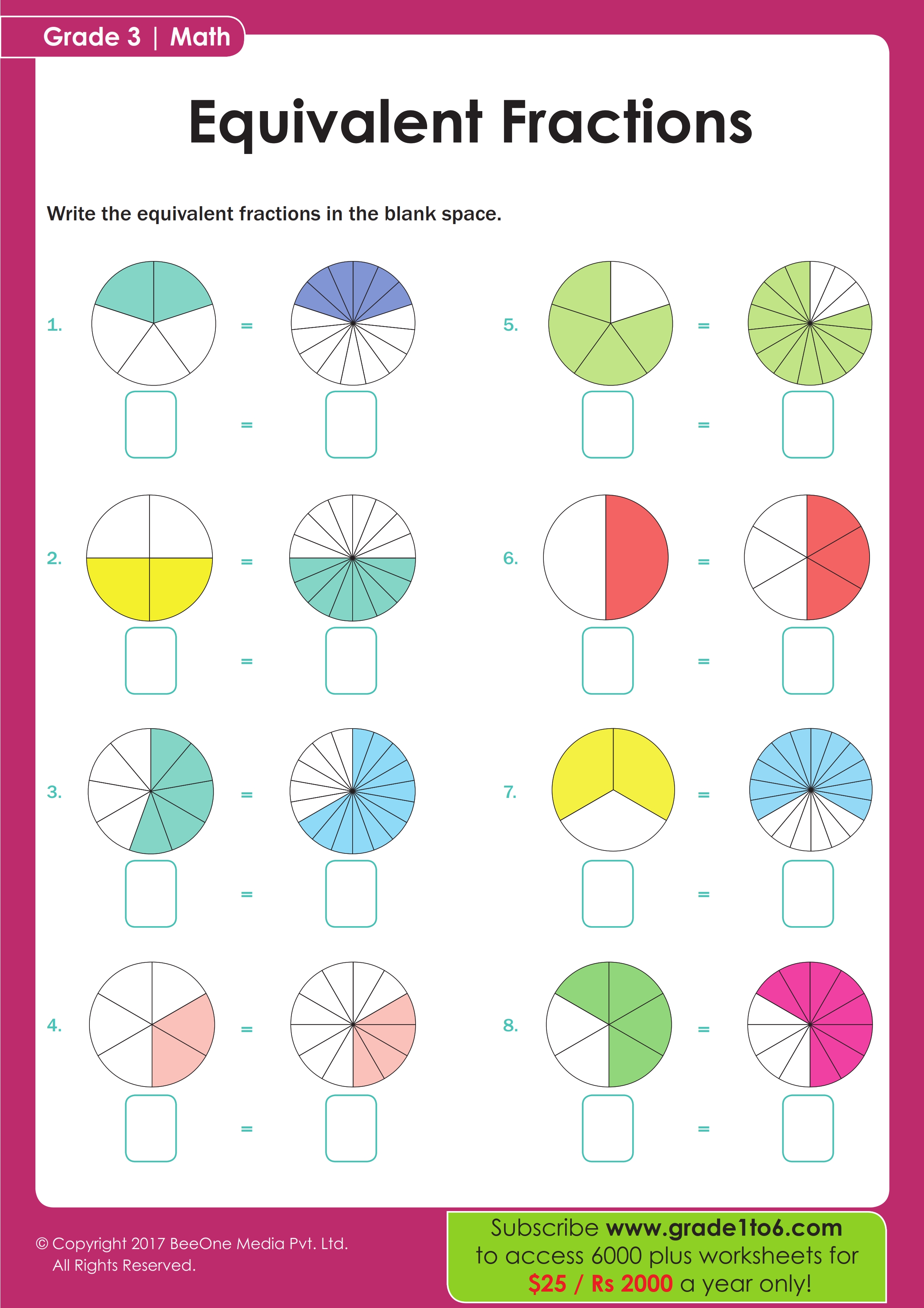
Grade 3 equivalent fractions
Targeting Specific Learner Needs
Equivalent fraction worksheets are designed to cater to a wide range of learner abilities and needs. For beginners, these worksheets often start with simpler activities, such as identifying equivalent fractions with a common denominator. As learners progress, the worksheets introduce more complex challenges, like finding equivalent fractions with different denominators or simplifying fractions to their lowest terms. This progressive approach ensures that learners can build confidence and skills step by step.
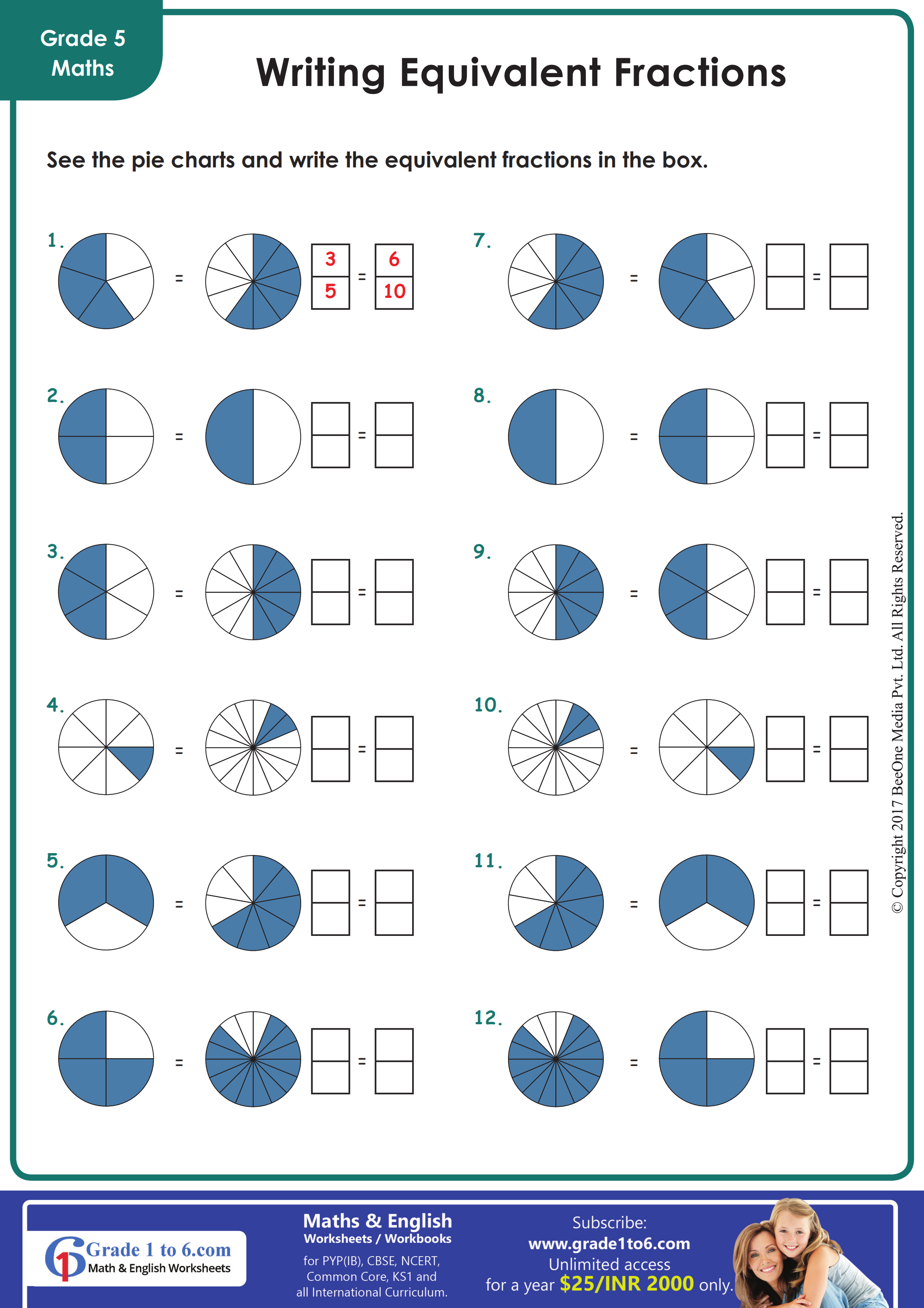
Grade 5 fraction practice sheets
Practical Applications: Classroom, Homeschool, and Beyond
The versatility of equivalent fraction worksheets makes them a valuable resource in various learning environments. In the classroom, teachers can use these worksheets to reinforce fraction concepts, provide extra practice, or even as a fun assessment tool. Homeschooling parents can incorporate them into their curriculum, offering a structured and engaging way to teach fractions at home. Tutors, too, can benefit from these worksheets, using them to identify and address specific learning gaps.
Fraction worksheets for grade 5
Moreover, equivalent fraction worksheets are an excellent resource for independent learning. Learners can work through the activities at their own pace, reinforcing their understanding and building confidence. The visual nature of the worksheets also makes them ideal for remote learning or as a supplement to online lessons.
5th grade equivalent fractions with key
People Also Ask: What Makes a Good Equivalent Fraction Worksheet?
When selecting an equivalent fraction worksheet, it's essential to consider a few key factors. Firstly, look for worksheets that offer a variety of activities and question types. This ensures learners don't become bored and helps keep their interest piqued. Additionally, consider the level of difficulty and ensure it aligns with the learner's ability. Worksheets should provide a gradual increase in challenge, allowing learners to build upon their skills.
Printable equivalent fractions practice
Another important aspect is the clarity of the worksheet. Clear instructions and well-designed visuals are crucial for effective learning. The worksheet should be easy to follow, with a logical progression of activities. Finally, consider the overall layout and design. A visually appealing worksheet can enhance the learning experience and make it more enjoyable for learners.
Equivalent fractions test prep
How to Use and Print Equivalent Fraction Worksheets Effectively
To make the most of equivalent fraction worksheets, it's important to consider a few practical tips. Firstly, ensure you have a good-quality printer and adequate paper supply. This will ensure the worksheets are clear and easy to read. Consider laminating the worksheets for durability, especially if they will be used multiple times or by different learners.
Writing equivalent fractions exercise
When using the worksheets, create a dedicated workspace that is free from distractions. Provide learners with the necessary tools, such as pencils, erasers, and a calculator if needed. Encourage learners to work independently, but also offer guidance and support when required. Regularly review the learner's progress and provide feedback to ensure they are understanding the concepts.
Fraction worksheet for kids
Building Fraction Confidence: A Real-World Application
Equivalent fraction worksheets offer more than just academic practice. By mastering equivalent fractions, learners gain a valuable skill that can be applied in real-world scenarios. For example, understanding equivalent fractions is essential when dealing with recipes, measurements, or even financial calculations. It empowers learners to make informed decisions and solve practical problems.
Visual models for equivalent fractions
Furthermore, the skills developed through equivalent fraction worksheets extend beyond fractions. Learners enhance their critical thinking, problem-solving, and logical reasoning abilities. These transferable skills are beneficial across various subjects and real-life situations, making equivalent fraction worksheets a powerful tool for holistic learning.
Free equivalent fractions with answers
In conclusion, equivalent fraction worksheets are a versatile and effective resource for anyone looking to improve their fraction skills. With their visual approach, progressive activities, and real-world applications, these worksheets offer a structured and engaging way to master a complex concept. Whether in the classroom, at home, or for independent learning, equivalent fraction worksheets provide a valuable tool to build confidence and understanding in learners of all ages.
Hey there, math enthusiasts! We hope this blog has shed some light on the awesomeness of equivalent fraction worksheets. These worksheets are a fun and effective way to grasp a tricky concept, so why not give them a go?
Print out a few, gather your pens and pencils, and dive into the world of fractions. It's a great way to practice and improve your skills, and we'd love to hear how you get on. So, go ahead, give it a try, and don't forget to leave a comment and share your experiences below! We'd love to hear your thoughts and any fun stories you have about your fraction adventures!
Four 4's activity sheet
Read also: 13 Bouquet Coloring Pages to Print
Related: 50 Christmas Worksheets Your Kids Will Actually Finish
Let's be real — the countdown to Christmas break hits different when you're staring down a stack of half-finished lessons and a room full of kids who've already checked out. That's exactly why printable worksheets christmas are the unsung heroes of December. They're not just time-fillers; they're sanity-savers that turn that chaotic stretch into something you can actually manage without losing your mind.
Look — you've got two weeks of sugar-fueled, glitter-covered mayhem ahead. The curriculum says you should be teaching, but the kids are mentally building snowmen and waiting for Santa. Here's the thing: fighting that energy is a losing battle. What actually works is meeting them where they are — with activities that sneak in learning while they're busy coloring reindeer or solving elf-themed math problems. The truth is, when you hand a kid a Christmas-themed worksheet, they don't see "schoolwork." They see a break from the usual routine. And that buys you the focus you desperately need right now.
But not all Christmas worksheets are created equal — which is probably why you've wasted time printing duds that got crumpled in five minutes. What I'm going to show you are the ones that actually hold attention, save you prep time, and somehow keep the room from descending into full-blown holiday chaos. I've got a few strong opinions on what works and what's a total waste of paper. Stick with me — this is the good stuff.
Here's what nobody tells you about keeping kids busy during the holiday season: the best activities aren't the flashy ones. They're the ones that let a child sit down with a crayon and actually think. I've watched too many parents burn money on elaborate Advent kits that end up forgotten by December 3rd. Meanwhile, a stack of printed pages—carefully chosen ones—can buy you thirty minutes of quiet focus while you wrap presents or sip coffee that's still warm. That's not a small thing.
Why Simple Holiday Printables Beat Store-Bought Activity Books
Store-bought activity books have one massive flaw: they're one-and-done. You finish the maze, you close the book. With a digital file you print at home, you can run off five copies of the same snowflake symmetry page if your child loves it. You can print one page at a time, matching difficulty to your child's mood that day. This flexibility is the single biggest advantage of downloadable holiday materials—you control the pace, not a publisher in New York. I've seen a reluctant reader spend twenty minutes on a simple word search simply because it had Santa and reindeer on it. That same child would have refused a standard workbook. The holiday theme does something to their brain; it lowers the resistance. Another thing: you can mix and match. One child might love counting ornaments, another prefers tracing letters. Print what works, skip what doesn't. No waste, no guilt.
How to Choose Pages That Actually Hold Attention
Not all holiday activity sheets are created equal. The ones that work best have a clear visual hook—bright illustrations, a character they recognize, or a puzzle with a satisfying endpoint. I've found that pages with a completion goal—like a connect-the-dots that reveals a gingerbread house—keep kids engaged far longer than open-ended coloring pages. The trick is to offer two or three options and let them pick. Choice matters more than content sometimes. For older elementary kids, look for hidden picture puzzles or simple crosswords with holiday vocabulary. For preschoolers, stick to big shapes and thick lines. Matching games printed on cardstock can be cut out and reused all season—that's a practical tip that saves you from printing the same thing twice.
The One Mistake Parents Make With Holiday Printables
Here's the hard truth: printing fifty pages at once and handing over the whole stack is a disaster. Kids get overwhelmed. They flip through, scribble on three, and declare boredom. The most effective approach is to offer one page at a time, like a single serving. Keep the rest in a folder and pull out a fresh one when the first is truly finished. This builds anticipation. It also teaches a subtle lesson about finishing what you start. I do this with my own kids, and it works because the novelty stays high. If you're using printable worksheets christmas sets that include multiple skill levels, sort them by difficulty before you print. Label three envelopes: "Easy," "Medium," "Hard." Let the child choose which envelope to draw from. That small ritual turns a simple printout into a game.
Practical Ideas for Using Printed Holiday Activities
- Morning quiet time: Print a single page and set it at the breakfast table with crayons. It's a low-pressure start to a chaotic day.
- Travel companion: Slip a few pages into a plastic sleeve with a dry-erase marker. Wipe clean, reuse. Perfect for restaurant waits or car rides.
- Gift topper: Roll up a completed coloring page and tie it with ribbon on a present. The child who made it feels proud, and the recipient gets a handmade touch.
When to Print and When to Skip
Not every holiday moment needs a worksheet. If kids are building a gingerbread house or decorating the tree, let them be. Printables are a tool, not a curriculum. Use them during the lulls—after school before dinner, on a snowy Saturday morning, or when you need twenty minutes to make a phone call. The best printable worksheets christmas resources I've found come from sites that offer a mix of math, literacy, and pure fun. Look for sets that include a variety of tasks, not just twenty versions of the same thing. One good page with a hidden picture is worth more than ten generic coloring sheets. Trust your child's signals. If they're engaged, great. If they're not, put the paper away and try again tomorrow. The holiday season is long enough for second chances.
Your Next Step Starts Here
Christmas has a funny way of reminding us what we truly value—connection, creativity, and the joy of giving something personal. In the rush of holiday planning, it’s easy to let those moments slip through your fingers. But the activities and ideas you’ve explored here aren’t just about keeping kids busy; they’re about carving out real, unhurried time with the people who matter most. That’s the gift that keeps giving long after the tinsel comes down.
Maybe you’re thinking, “I’ll come back to this later when I have more time.” I get it—I’ve said the same thing, and then December 23rd arrives in a blur. Here’s the truth: you don’t need a perfectly scheduled afternoon. Even fifteen minutes with a pair of scissors and a printed page can spark the kind of laughter that becomes a core memory. Don’t let the myth of “not enough time” steal that from you. The hardest part is simply starting—and that starts right now.
So go ahead: bookmark this page, print out a few of your favorites, or forward the link to a fellow parent who looks like they could use a break. Your holiday self will thank you. And when you’re sipping cocoa while the kids are quietly engaged with their printable worksheets christmas activities, you’ll know you made the right call. Printable worksheets christmas resources like these are here to help you reclaim the season—one small, joyful moment at a time.
Related: Free Printable Cognitive Therapy Worksheets for Adults (PDF)
Your mind is a battlefield, and the war is real. Every day, you’re bombarded with thoughts that can either lift you up or drag you down. That’s where adult cognitive therapy worksheets come in—they’re not just pieces of paper; they’re tools to rewrite the script in your head. Honestly, if you’ve ever felt stuck in a loop of negative thinking, these worksheets are like a map out of the maze. They’re designed to challenge the way you think, helping you swap out self-sabotage for self-awareness.
Right now, stress and anxiety are at an all-time high. Whether it’s work, relationships, or just the chaos of life, your brain is constantly under siege. These worksheets aren’t just for therapists—they’re for you, the person who’s tired of feeling overwhelmed but doesn’t know where to start. They’re practical, actionable, and, most importantly, they work. Look, we’ve all been there: lying awake at 2 a.m., replaying conversations or worrying about the future. This isn’t about fixing everything overnight, but it’s about taking the first step toward clarity.
What if you could quiet the noise in your head and actually enjoy your own company? What if you could make decisions without second-guessing every move? That’s what’s waiting for you here. No fluff, no jargon—just straightforward strategies to help you think differently. And hey, let’s be real: life’s too short to spend it tangled in your own thoughts. Stick around, and you’ll see why these worksheets are more than just exercises—they’re a lifeline.
The Part of Adult Cognitive Therapy Most People Get Wrong
When it comes to cognitive therapy, many people assume it's all about changing negative thought patterns and behaviors. And while that's a big part of it, the real key to success lies in understanding the underlying cognitive processes that drive those thoughts and behaviors. Here's what nobody tells you: it's not just about identifying and challenging negative self-talk, but also about developing a deeper understanding of how your brain works. For instance, have you ever noticed how your thoughts can spiral out of control, leading to feelings of anxiety or overwhelm? and yes, that actually matters because it can impact your ability to make positive changes in your life.
The Importance of Self-Awareness
Self-awareness is a critical component of cognitive therapy, and it's something that many people struggle with. It's not just about being aware of your thoughts and feelings, but also about understanding how they impact your behaviors and relationships. By developing greater self-awareness, you can begin to identify patterns and habits that may be holding you back, and start to make positive changes. One actionable tip is to start keeping a thought journal, where you write down your thoughts and feelings throughout the day. This can help you identify patterns and gain a deeper understanding of your cognitive processes.
Using Cognitive Therapy Techniques
There are many different techniques that can be used in cognitive therapy, including cognitive restructuring, mindfulness, and problem-solving. The key is to find what works best for you and to be consistent in your practice. One technique that can be particularly helpful is cognitive restructuring, which involves identifying and challenging negative thought patterns. This can be done using a variety of tools, including adult cognitive therapy worksheets, which can provide a structured approach to identifying and challenging negative thoughts.
Putting Cognitive Therapy into Practice
Real-World Applications
So how do you put cognitive therapy into practice in your everyday life? One way is to start small, by identifying one area where you'd like to make a change. This could be something as simple as reducing stress or improving your relationships. From there, you can start to use cognitive therapy techniques, such as mindfulness or problem-solving, to work towards your goal. It's also helpful to have a support system in place, such as a therapist or support group, to provide guidance and encouragement along the way. By taking a proactive approach to your mental health, you can start to make positive changes and improve your overall well-being. For example, you can use the following table to compare different cognitive therapy techniques and find what works best for you:
| Technique | Description | Benefits |
|---|---|---|
| Cognitive Restructuring | Identifying and challenging negative thought patterns | Reduced stress and anxiety, improved mood |
| Mindfulness | Practicing present-moment awareness | Reduced stress and anxiety, improved focus |
| Problem-Solving | Identifying and solving problems in a logical and methodical way | Improved coping skills, reduced stress and anxiety |
Your Journey to a Clearer Mind Starts Now
In the grand scheme of life, taking control of your thoughts and emotions is one of the most empowering steps you can take. It’s not just about managing stress or overcoming challenges—it’s about unlocking your full potential. Whether you’re aiming to improve relationships, boost productivity, or simply find more joy in daily moments, the tools you’ve explored here are your stepping stones to a more intentional, fulfilling life. Adult cognitive therapy worksheets aren’t just exercises; they’re a way to rewrite the narratives holding you back and craft a mindset that serves you better.
You might be thinking, “But what if I’m not consistent?” or “What if it doesn’t work for me?” Here’s the truth: progress isn’t about perfection. It’s about showing up, even when it feels small. These worksheets are designed to meet you where you are, no matter your starting point. They’re flexible, adaptable, and rooted in proven strategies. So, take the pressure off—this is your journey, at your pace.
Ready to take the next step? Bookmark this page so you can return whenever you need a refresher. Or, share it with someone who might benefit from these insights—sometimes, the best way to solidify your own learning is by passing it forward. And if you’re eager to dive deeper, explore the gallery of adult cognitive therapy worksheets to find the ones that resonate most with you. Your clearer, calmer mind is waiting—go ahead and take the leap.


